We introduce Long Listening Thoughts (LLT), a framework for constructing post-training datasets that improves audio reasoning by pairing deliberate perceptual grounding with explicit cognitive behaviors.
On audio understanding and reasoning benchmarks, large audio–language models (LALMs) are limited primarily by perceptual errors, yet existing post-training datasets rely on audio descriptions of limited diversity. Through a four-stage pipeline, LLT (1) builds multi-aspect dense audio descriptions spanning semantic, acoustic, and temporal information, (2) generates more challenging questions, (3) synthesizes incorrect reasoning traces, and (4) extends short reasoning traces into long ones via a thought-continuation strategy that elicits cognitive behaviors such as verification and backtracking.
Using LLT, we synthesize 1.6M reasoning traces and train Qwen2.5-Omni-7B with a two-stage pipeline of supervised fine-tuning (SFT) followed by direct preference optimization (DPO). This improves accuracy on MMAU Test-mini (71.5 → 78.2), MMAR (56.7 → 63.7), and MMSU (60.6 → 66.0).
A four-stage pipeline that synthesizes 1.6M long reasoning traces from an existing short audio CoT dataset.
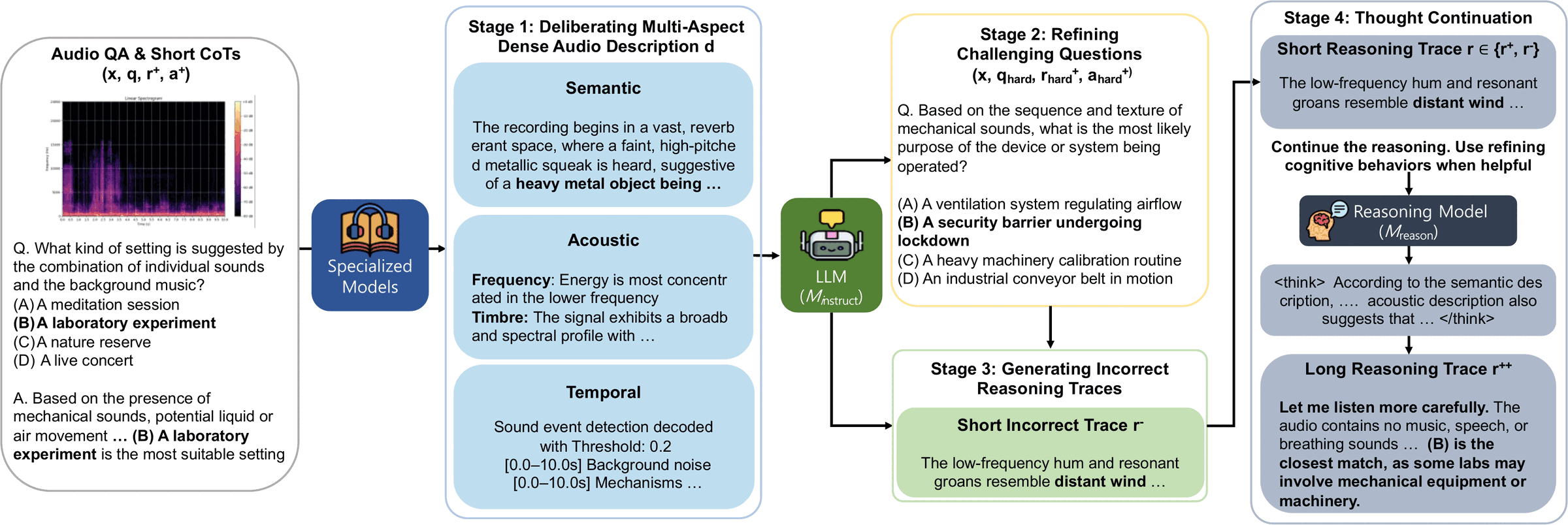
<think> block and emit the refined continuation in the
<answer> block.
For each source example, LLT incorporates multiple reasoning trace types: short correct r⁺, correct-to-refine r⁺ → r⁺⁺, and incorrect-to-correct r⁻ → r⁺⁺. Stage 2 additionally produces a harder challenging question on the same audio.
Comparing Qwen2.5-Omni-7B + AF-Think (baseline) and Qwen2.5-Omni-7B + LLT (SFT → DPO) (ours).
If you find this work useful, please cite:
@inproceedings{llt2026,
title = {Long Listening Thoughts: Eliciting Open Auditory Reasoning
with Deliberative Perception and Cognitive Refinement},
author = {Kim, Jaeyeon and Yang, Chao-Han Huck and Zhang, Luoyi and
Hsu, Chan-Jan and Ruiloba Portilla, Fernando and Tian, Jinchuan and
Watanabe, Shinji and Busso, Carlos},
booktitle = {Findings of the Association for Computational Linguistics: EMNLP 2026},
year = {2026}
}